

Can Hypnosis Really Change Your Public Speaking Skills?
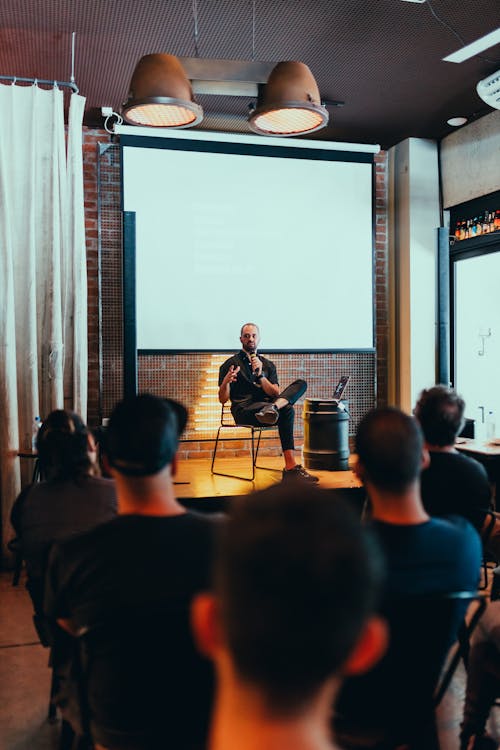 For many people, standing in front of an audience feels like walking into a storm unarmed. The pounding heart, shaky hands, and racing thoughts take over. Even if you know you enjoy presenting and speaking publicly, there are moments when you can’t seem to stop your body from flipping straight into the stress response. This is exactly what happened to someone I worked with to help them overcome their public speaking anxiety.
You see, they didn’t fear speaking in front of an audience. It is something they have done for many years – so much so they enjoy it. In fact, some words they used to express their feelings about presenting their work were; excited, confident, proud, love. Unfortunately, their excitement was diminishing and their confidence crumbling, as every time they took to the floor, their body became a separate entity. While they wanted to be there, sharing the work they enjoy so much with a group of people wanting to hear about it, something caused a physical reaction. They began to feel dizzy and faint, their breathing changed, causing a shortness of breath, and they felt themselves breaking down. They lost their words, and the fear of collapsing on stage forced them to take a moment, let someone else take over, and continue once they’d retrieved control.
The Unconscious Side of Anxiety
The above experience is confusing, you don’t feel nervous. You know your content. You’re excited to share the content. You don’t even worry about standing in front of a group and holding the limelight. So, what is happening?
 Like all animals, you have a limbic system. This is the part of your brain that holds the power to your emotions, instincts and survival response. Some people call it the reptilian brain or the primal brain, because it is the animal part of your brain. The human part is the one in the background screaming… BUT I’M ENJOYING THIS! The limbic system is fully in control of your stress response, also known as the fight or flight response, the fight, flight or free response and the anxiety response. There are minor nuances to the terms, but they all refer to the survival response. This is your body trying to help you get out of (what it perceives) a very dangerous situation.
Any experience of this will show you how little power the human brain has over the primal. In that moment, your conscious thought skews, you feel physically unsteady and emotionally bewildered. It is hard to communicate, and your feelings can range from uncertain to terrified. It’s understandable that any experience of this can cause you to fear another episode. Which becomes the problem. If you still feel no fear of public speaking, you’ll probably fear another moment like this. Especially in a situation where there is no backup, no colleague to pass over to. No option to take a minute to recombobulate yourself. This is the situation my client found themselves in, and why they sought my help to improve their public speaking skills.
Understanding the Physical Symptoms of Anxiety: What’s Going On?
 It’s natural to want to know why your body reacts like this. Why, when you enjoy public speaking, does your body want to shut down? It is a good question, but not always necessary. My client and I had two sessions to improve their public speaking skills and get presentation ready. It might have taken us months to get to the bottom of it. The why is interesting, and sometimes the answer to recovery. In this situation, the only why my client needed answering was why were these physical things happening. And it was a very simple answer.
When your body moves into the stress response, it quickly moves energy from storage sites to get to the muscles needed to flee or fight. The body wants this to happen quickly, so it increases your heart rate, blood pressure, and breathing rate to transport the nutrients and oxygen as quickly as possible.
There is more depth to this, during the session, I explained other physical manifestations of the stress response, such as the pupils dilating. I also recommended my client read The Anatomy of Anxiety by Dr. Ellen Vora. It is all well having your hypnotherapist explain the anxiety response, but an hour is not a long time for them to fit in a clear explanation of anxiety in such a way you’ll remember it fully, give you time to speak and do some hypnosis. This is an easy read book that I will recommend when time is tight. My client read it in their own time between sessions, which advanced their understanding and optimised the time in sessions, giving space for deeper hypnotic work.
Overcoming Public Speaking Anxiety: Session Tools and At-Home Exercises
The direction of my client’s career rested on their presentation, and they smashed it. There were three key ingredients to this success. Their imagination, mindfulness, and lifestyle changes.
In addition to understanding the physical manifestation of anxiety, my client also needed to know that their body moves into this response when the limbic system perceives something as a threat to their life. Hence why we sometimes try to find the why. Why is your brain perceiving this situation as a threat to your life? Generally, it’s an instinctual reaction (an evolutionary reaction there for survival, e.g. loud noises, falling, predators). A learned fear – something you picked up from someone else. Or a fear developed through personal experience. Regardless of the why, my client’s limbic system had a file in it that said public speaking is a threat to their life. Our task was to shred it.
Imagination & Public Speaking Skills

Your brain reacts in the same way when you imagine something to when you do it. In my client’s case, this was important for two reasons. Firstly – was it their imagination that caused the fear in the first place? Because your imagination is so powerful, you can use it to develop a fear. Had they imagined a ghastly situation so much their brain was doing it’s best to keep them away from the horror of it? Possibly – but remember we didn’t have time for the why. My client needed to use their imagination to readjust the belief in their limbic system. My client had to go all out and move the conscious thoughts of excitement, pride, love and enjoyment to the limbic system. They did this using their imagination. My client searched the internet to find a picture of the presentation room, so they could visualise themselves in it. Every day they took time to imagine themselves presenting in extreme detail. We used hypnosis to increase the depth of this, they included feelings and subtleties like the curtains or blinds in the room. They included their stance and what that felt like. We scrutinised every inch of the experience and brought it into the imagination. The limbic system only alerts you to something it feels is a threat to your life. Using the reality Vs imagination hack, we stored the presentation as a safe experience in their brain.
Mindfulness
Mindfulness is a way of life developed through specific exercises to keep your mind in the present moment. Using mindfulness, you can take control of your thoughts, so they don’t run off into regrets or future what ifs. The physical manifestation of the stress response can feel so scary, with limited understanding, it is easy to fall quickly into the black hole of despair. This is what happened to my client whenever they felt the beginnings of it. Within seconds, their conscious mind told them they were about to faint, and they needed to get out of there immediately. Using mindfulness techniques (including meditation every day,) my client was able to explore these physical feelings with curiosity and remain in the present moment with the knowledge their body is functioning as it is designed to, and they are OK.
Self-hypnosis without an intended solution is the same as meditation. You can use meditation / self-hypnosis to bring your body back into the allostatic state with a strong ability to focus. My client did this every day and twice in the morning before the presentation.
Lifestyle changes
 Finally, but as importantly, there are some lifestyle choices that can increase anxiety. In the previously mentioned book, Vora separates true anxiety from false anxiety. True anxiety is what I described, your body recognising something as a threat and reacting to keep you alive. False anxiety is when something in your life causes feelings like the anxiety response. This creates a vicious circle in which you wonder what’s wrong, panic and create anxiety. My client did fear the presentation, they feared their reaction to the presentation and their subsequent lack of control over this. Alcohol, lack of sleep, caffeine, dark chocolate and erratic blood sugar can all cause physical feelings that feel like the stress response. It was important my client kept a check on this, because any slight feeling of discomfort could start the snowball in action.
Can Hypnosis Really Change Your Public Speaking Skills?
Hopefully, you can now see, the answer is yes! It is possible to break the cycle of anxiety that takes over during public speaking, even if you don’t know why it’s happening. In the case of my client, using tools like visualisation, mindfulness meditation, and self-hypnosis helped them regain control over their body’s response. Whether you suffer from public speaking anxiety, fear of presentations, or simply struggle with stress management, hypnosis is a valuable tool in overcoming these challenges.
 Welcome to my website, a space where I try to catch your eye, and explain the heart of my practice.
My journey over 16 years has taught me that true knowledge isn’t about the letters after my name or the timeline of my academic pursuits. It’s about the stories shared, the moments of vulnerability, and the human connection that transforms both you and me. It’s holding space, listening intently, and noticing the patterns within your words and emotions.
Together, we can navigate the complexities of life, embracing both the shadow and the light. So, if you’re seeking more than just a quick fix, and ready to make lasting changes, you’re in the right place. Let’s embark on this journey together. Read more about my approach here.